A structured, intuitive digital patient file
Everything below is in the product today. The screenshots are the real application, not mock-ups.
Clinical information
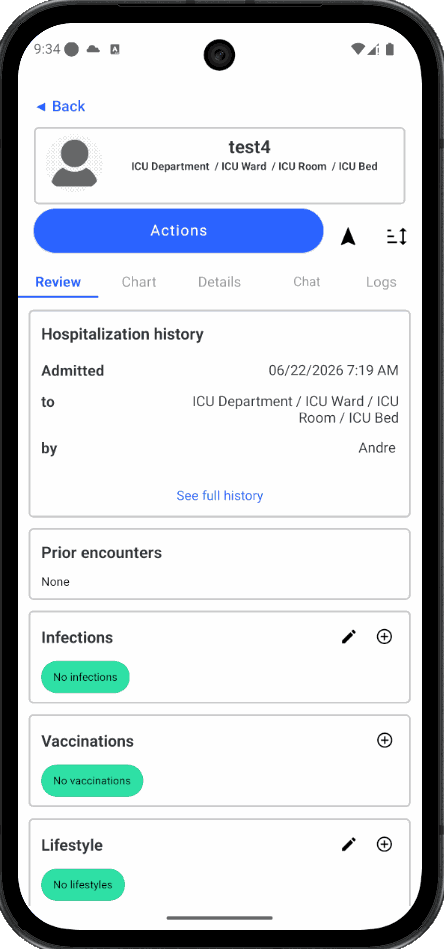
One record per patient, in a fixed order, so information is always in the same place no matter who is looking.
- Anamnesis — the history in the patient's own terms
- Symptoms — recorded as structured entries, not buried in prose
- Allergies and infections — pinned to the top of every screen
- Risk flags — configurable warnings such as risk of falling
- Vaccinations
- Diagnoses and chronic conditions, ICD-10 coded
- Vitals and clinical observations over a selectable time frame
- Clinical notes and clinical photos
- Home medication as the patient arrived on it
Chat, in the patient's context
Useful immediately — because it works the way the messaging app on everyone's phone already works.
- Conversations attached to the patient, so context is never re-explained
- One-to-one and group chats
- Pictures and videos, across departments
- A photograph of a wound goes into the record, not into a camera roll
- Continuity across shift changes
Patient context
The conversation lives on the patient, so nothing has to be re-explained.
1-on-1 and group
Reach an individual or the whole team caring for that patient.
Photos and video
A wound photo goes into the record, not into a camera roll.
Across the shift
Handover reads back through the thread instead of relying on memory.
A pharmacy view of the whole hospital
Developed for the African Union tender, the pharmacy view turns the patient list into a medication list — grouped by department and ward, with dosage, form and frequency at a glance.
- Every admitted patient's active medication in one screen
- Grouped by department, ward, room and bed
- Dosage, form and frequency in the familiar 1-1-1-1 notation
- Built for the people who actually dispense
Every active order
All medication for admitted patients on one screen.
Grouped by ward
Department, ward, room and bed, the way the round runs.
Dosage and frequency
Strength, form and the familiar 1-1-1-1 notation.
Built for dispensing
Designed with the people who actually hand out the drugs.
The awkward cases, handled properly
Every hospital has them. Most systems pretend they do not exist.
VIP identity protection
A patient whose presence in the hospital is itself sensitive can be shielded from casual browsing, while the clinical team keeps working normally.
Unknown patient support
Someone arrives unconscious with no documents. You still need a record from the first minute — and a way to merge it once they are identified.
Password for relatives
A credential you can give a family member so information is released to the right person, and only to them.
Hospitalization history
Previous encounters are searchable, so a returning patient does not start from a blank page.
Post-transfer recommendations
What the receiving team needs to know and do, written down at the moment of transfer rather than remembered later.
Full audit log
Who viewed the patient, who created which document, and exactly when. Responsibility and transparency as a feature.
An audit trail you can actually read
Every action against a patient is recorded with the person's name, the action and the timestamp — including simply opening the record.
PATIENT_VIEWED— someone opened this recordCLINICAL_DOCUMENT_CREATED— with the document and its date- Named to the individual user, not to a shared ward login
- Visible in the app, in the patient's own Logs tab
Who opened the record
Every view is recorded, not just every change.
What was created
Documents, notes and results, with their timestamps.
Named to a person
Individual users, never a shared ward login.
Visible in the app
In the patient's own Logs tab, not a separate system.
More that comes with it
AI analysis of the record
Pulsonics can analyse a patient's record for risks, problems and suggested next steps — a second pair of eyes on a long chart.
Configurable special warnings
Define the flags your hospital cares about — risk of falling, isolation, anything else — and they appear where they cannot be missed.
Offline with automatic sync
Document without a connection; Pulsonics synchronises as soon as one is available.
Rapid localisation
English, French, Portuguese and German today. A new language can be added within hours, not releases.
AWS or your own hosting
Deploy on AWS, or have the environment managed on your side. Both are supported configurations.
Encrypted end to end
Clinical data is encrypted on the device — the assumption being that devices are shared and sometimes lost.
Want to see it running?
A live walkthrough on a test tenant, with your workflows — not a slide deck.