
How do I digitalize my hospital?
It is a fair question, and for most hospitals in the world the honest answer has been “you can't afford to”. Here is why — and what we changed.
Why is your hospital not yet digital?
The objections we hear are consistent, and all of them are reasonable.
Expensive
The licence is rarely the problem. The infrastructure around it is.
Long and complex projects
Multi-year programmes that outlast the people who commissioned them.
Requires hardware and network infrastructure
Cabling, switches, server rooms, power — in buildings that were never designed for it.
Difficult to learn and use
Systems designed for a trained data-entry clerk, not a nurse mid-shift.
Requires desktops and notebooks
Which means fixed workstations, which means documentation happens later — or not at all.
Old technology
Interfaces and assumptions from an era before everyone had a smartphone.
What makes it so expensive?
The EMR software is one line on the invoice. This is the rest of it — and it adds up to a five-year total cost of ownership of at least USD 1,000,000.
Power
Electricity, generator, batteries — because the servers cannot go down.
Network
Switches, routers and cabling through every ward you want covered.
Endpoints
Computers, screens, carts — and the physical space to put them.
Back end
Servers, operating systems, database software, virtual desktops, more servers — and the IT staff to run them.
So why not stay on paper?
Paper is cheap to buy and expensive to rely on. Two things go wrong, and both of them matter to the patient.
Information gets lost
- Allergies — not where the next clinician looks
- Infections — discovered late, or not at all
- Previous encounters — effectively unsearchable
Patients notice
Patient perception of a hospital is shaped by the food, by how responsive the staff are — and by how digital the place feels. A clipboard says something about your hospital whether you intend it to or not.
A large share of what looks like a billing problem, or a quality problem, is really a documentation problem. If the ward round is captured badly, everything downstream inherits the damage.
What a mobile EMR actually has to do
Before building Pulsonics we wrote down the requirements. Miss any one of them and you are back to a desktop system with a phone app bolted on.
Apple and Android
Both platforms, first class. You buy the devices that are available and affordable where you are.
Smartphones and tablets
The same record on a phone in a pocket and a tablet at the nurses' station.
(Private) cloud-based
Hosted on AWS or under your own management — no server on your premises either way.
Data fully encrypted
End-to-end, on the device. A shared phone must not be a data breach.
Flexible and low cost
Priced so a district hospital can say yes, and structured so you can start small.
Highly portable
The record goes where the clinician goes — between wards, buildings and sites.
Pulsonics requirements for hospitals
Short list, and deliberately so. If you can meet these three, you can run Pulsonics.
Stable 4G/5G coverage or Wi-Fi
Not perfect coverage — Pulsonics works offline and syncs when the signal returns. But it needs to reconnect sometimes.
Issue smartphones to staff
Android-based smartphones start at around USD 100 per device. Your partner can bundle them with the software.
Offer on-site first-level support
Forgotten passwords, creating user accounts, and logging issues and enhancement requests with us. Everything else is ours.
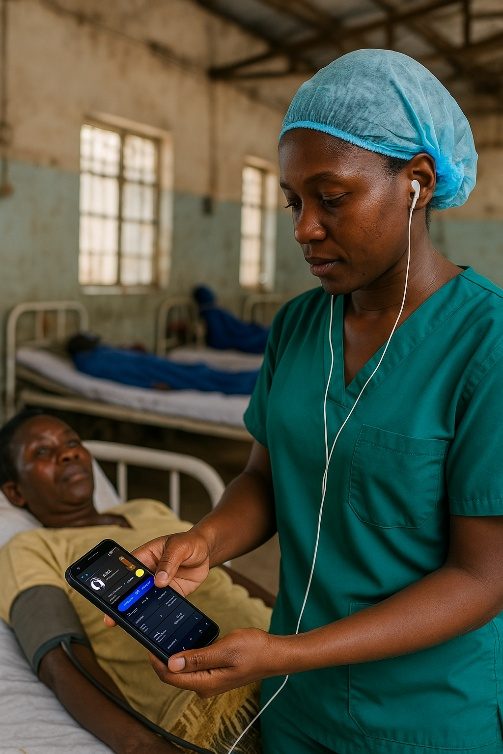
Could this work for your hospital?
Tell us your setting — beds, departments, connectivity — and we will tell you honestly whether Pulsonics fits.